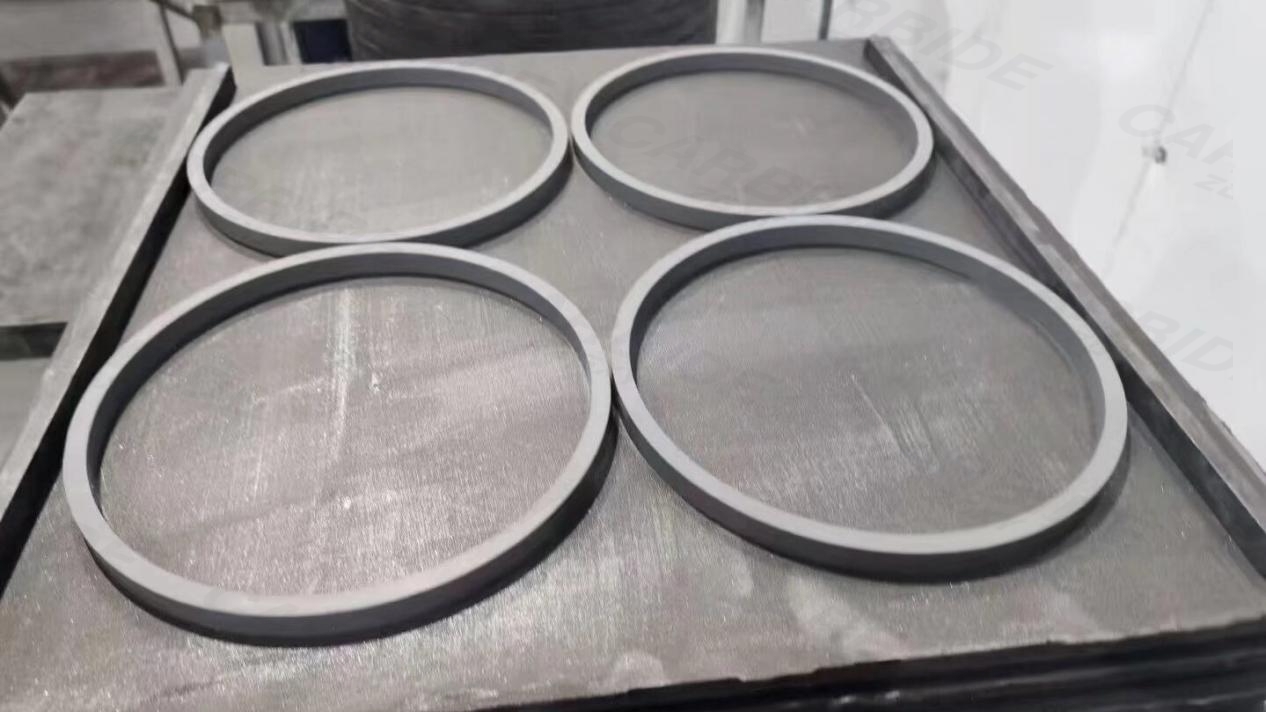
Optimization of Cemented Carbide Microstructure via Low-Pressure Sintering (Sinter-HIP)
Compared to traditional standalone Hot Isostatic Pressing (HIP), Low-Pressure Sintering—widely known as Sinter-HIP—is a highly advanced, integrated approach. Rather than transferring parts between different machines, this technology combines dewaxing, pre-sintering, vacuum sintering, and isostatic pressing into a single continuous cycle within one state-of-the-art furnace.
During the Sinter-HIP process, the application of moderate argon gas pressure (5–6 MPa, or approx. 50–60 bar) drastically accelerates particle movement and rearrangement. Because of this pressure assistance, the required sintering temperatures and holding times are considerably lower than those in standard vacuum sintering (often reducing peak temperatures by 30°C to 50°C). Consequently, it is not that low-pressure sintering chemically suppresses grain growth; rather, full densification is achieved before the grains have sufficient time to grow. The dissolution-precipitation cycle is effectively shortened, inherently guaranteeing a near-theoretical density while maintaining an ultra-fine grain structure.
Furthermore, the pressurized gas acts isotropically within the furnace—much like a fluid hydraulic press—exerting uniform force across the entire workpiece to drive grain rearrangement and completely seal micro-porosities. The true brilliance of the Sinter-HIP process lies in its precise timing: the overpressure is applied exactly at the late stage of sintering when the liquid cobalt phase reaches its maximum volume fraction. Right before grain coarsening (Ostwald ripening) can occur, this pressure forcefully drives the liquid binder to fill any remaining internal voids, resulting in an exceptionally dense, defect-free metallurgical structure with superior transverse rupture strength (TRS).